The relatives are most often the people who first notice symptoms of dementia. Read the 10 warning signs so you know what to watch out for.
At the same time, Otiom ensures that if someone wanders, they can be found quickly and safely.
Buy for € 299 or rent for € 29 per month
Otiom is a small, simple and sturdy tag, which people with dementia carry on their person.
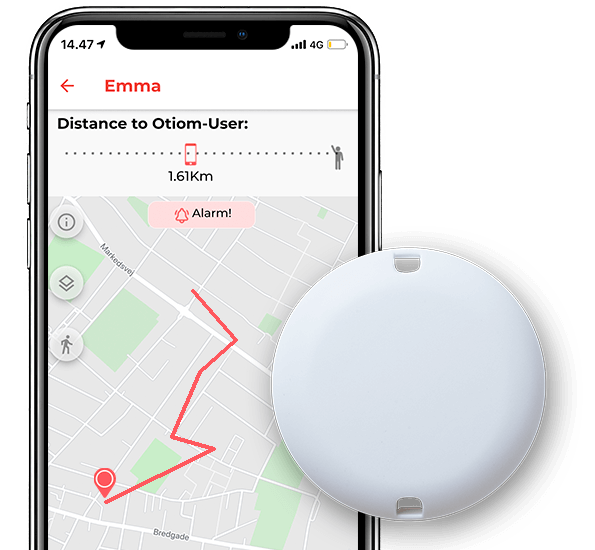
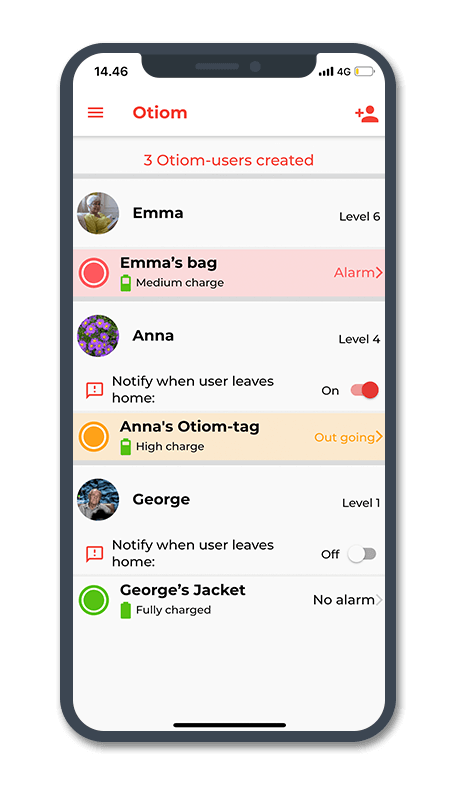
With the Otiom-app on your smartphone, you will be notified as soon as the person with the tag leaves home. You can also be notified when they leave a zone that you have defined – without the individual being continuously monitored.
Watch the video to see how Otiom works.
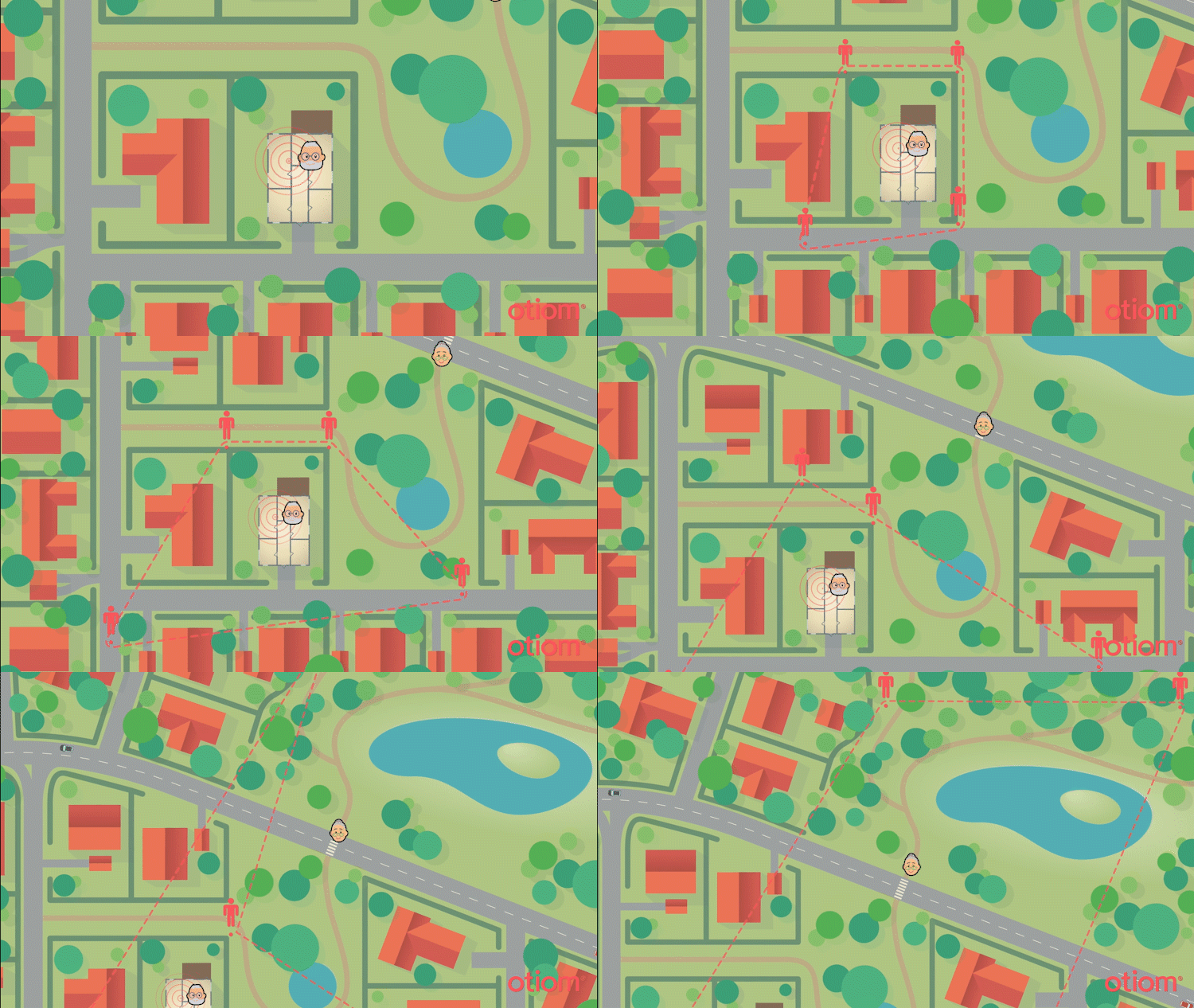
With the Otiom-app it is easy define safe zones, which are areas where the person with dementia can be without being monitored.
A safe zone could be your house and garden, the road where you live or the places you go for walks.
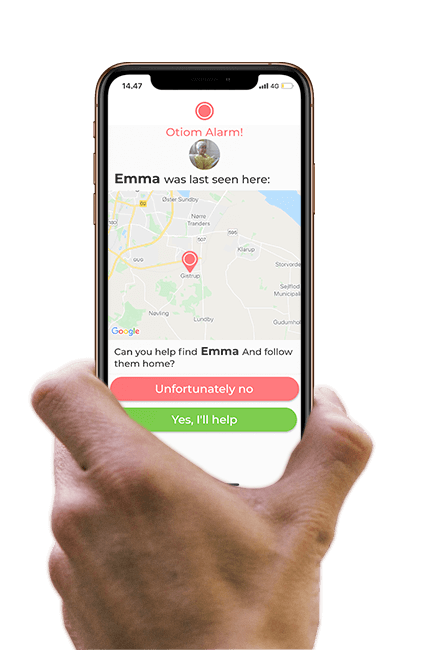
You will receive a message if the person with dementia strays outside the zone. Then you can quickly return them to safety.
In the Otiom-app, you can quickly set up zones where it is safe for persons with dementia to move about. This could be their home or a specific local area.
Otiom is the only tracking device on the market that also works indoors. This is extremely useful if the person with dementia goes down to the basement, to the garage or gets lost in a shopping centre or at the nursing home.
Otiom offers people with dementia the freedom to move about freely. The location of the individual is only shared with relatives once there is a risk of danger.
Otiom won’t suddenly run out of power right when you need it. You will automatically receive a message when it is time to charge the device.
Otiom’s design is the product of hundreds and hundreds of conversations and tests with persons with dementia, their relatives and caregivers.
Contrary to GPS watches (etc.), Otiom is designed to be entirely neutral and pleasant to the touch. Therefore, the Otiom-tag has no buttons, lights or charging plugs, which may confuse many people with dementia.
The Otiom-tag includes the new Internet of Things (IoT) technology. This means that it has a very long battery life, and it works where traditional GPS devices do not – including indoors.
The Otiom-tag weighs just 30 grams and takes up 5 x 1 cm. It has no distracting buttons, sounds, plugs or lights.
The Otiom-tag can run for up to one month on one charge, and it can be fully recharged in 2 hours. The tag saves power when inside the home. Battery usage increases when the tag is taken outside.
The Otiom-tag can be disinfected and machine-washed at up to 60 degrees Celsius. Each tag is individually pressure and waterproof-tested at a depth of 5 metres (IP68).
Otiom communicates using NB-IoT, via mobile phone masts. It also uses GNSS, which includes all global satellite systems (including GPS) as well as Bluetooth 5.X.
Otiom is a fantastic solution, which is useful in nursing homes and for family members. That’s very important to us.
Otiom’s product for people with dementia is simple and brilliant, and it comes with a long battery life and all sorts of other benefits. In particular, it allows you to adjust the geographic area where the person with dementia can move about, as their condition deteriorates.
Otiom gives me peace of mind. I know that I will be alerted if my husband moves out of the local area, and I can change the safety level myself to fit our needs.
I certainly feel safe knowing that she (my wife) can keep track of me. And the tag weighs nothing and takes up no space, so it’s easy to bring along.
It works really well, and it is easy to set up and use.
Otiom is a fantastic solution, which is useful in nursing homes and for family members. That’s very important to us.
Otiom’s product for people with dementia is simple and brilliant, and it comes with a long battery life and all sorts of other benefits. In particular, it allows you to adjust the geographic area where the person with dementia can move about, as their condition deteriorates.
Otiom gives me peace of mind. I know that I will be alerted if my husband moves out of the local area, and I can change the safety level myself to fit our needs.
I certainly feel safe knowing that she (my wife) can keep track of me. And the tag weighs nothing and takes up no space, so it’s easy to bring along.
It works really well, and it is easy to set up and use.
Otiom uses several new technologies, which together result in very low power usage for the Otiom-tag. If you want to learn more about the technology in Otiom, you can read about it here.
Otiom can locate someone both indoors and outdoors.
It can help you when a resident is hiding in a room or has wandered during an outing.
The Otiom-tag can be carried or mounted in many different ways. Here are some suggestions:
Mounted on a walking frame, a cane, wheelchair, etc.
Yes, the Otiom-tag is waterproof, it can be disinfected and can be machine-washed at up to 60 degrees Celsius.

The relatives are most often the people who first notice symptoms of dementia. Read the 10 warning signs so you know what to watch out for.

Location systems for people with dementia utilise different technologies and work in different ways. Here you can see a summary.

The right aids may help memory or provide reassurance for people with dementia and their relatives – for example location systems and electronic calendars.

GPS monitoring can save lives when people with dementia wander. However, there are both ethical and technical challenges with the GPS system.
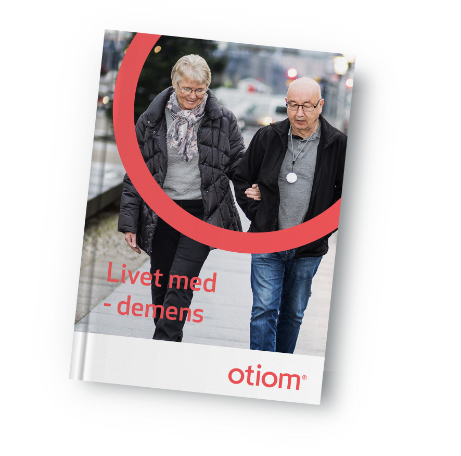
Tilmeld dig nyhedsbrevet for demensskolen og Otiom, og modtag råd og vejledning til hvordan du hjælper en pårørende med demens, og selv får mere overskud. Nyhedsbrevet udsendes hver 14 dage, og du kan afmelde dig når som helst.